Start here
Is a torsion conversion worth it?
Short answer
A conversion makes the most sense when your side extension springs need replacing anyway and the garage has headroom above the door for a shaft. The torsion setup lifts the door more evenly from both ends, keeps the springs on one bar over the opening, and takes the stretched springs and pulleys off the horizontal tracks.
The job
What changes when a door goes from extension to torsion
Extension springs run along the horizontal tracks on each side and stretch as the door closes. Each side lifts its own half of the door through a pulley and a cable, so if the two springs age differently the door lifts crooked. When one breaks, a properly installed containment cable through the spring keeps it from flying across the garage.
A torsion system moves the lifting to a single shaft over the opening. Springs wind around the shaft, cable drums at each end turn together, and both sides of the door rise at the same rate. The conversion removes the side springs, pulleys and their cables, mounts a center bearing plate into the header framing, and hangs new cables on the drums.
Cost
What moves the price of a conversion
A conversion is priced on the door in front of us: its weight, its headroom and the framing above it. You get that price before work starts.
- Door width and weight, which set the spring size
- Standard or low-headroom hardware
- Whether the header needs blocking for the center plate
- Cable drums and bearings needed
- High-cycle springs if you want them
Compare the options
Extension springs or torsion springs: how they differ
Both lift the door. They do it in different places and fail in different ways.
| Extension springs | Torsion springs | |
|---|---|---|
| Where they sit | Along the horizontal tracks | On a shaft above the opening |
| How the door lifts | Each side on its own spring | Both sides together through one shaft |
| When one breaks | Held by a containment cable | Stays on the shaft |
| Space needed | Side room along the tracks | Headroom above the door |
| Typical repair | Replace both side springs | Replace springs on the shaft |
What is included
What a conversion includes
- Torsion shaft, springs and end bearing plates
- Center bearing plate anchored into solid framing
- New cable drums and lift cables
- Removal of the extension springs, pulleys and old cables
- Spring sizing to the door's measured weight
- Balance test, opener reset and safety reverse check
Single-car door conversion
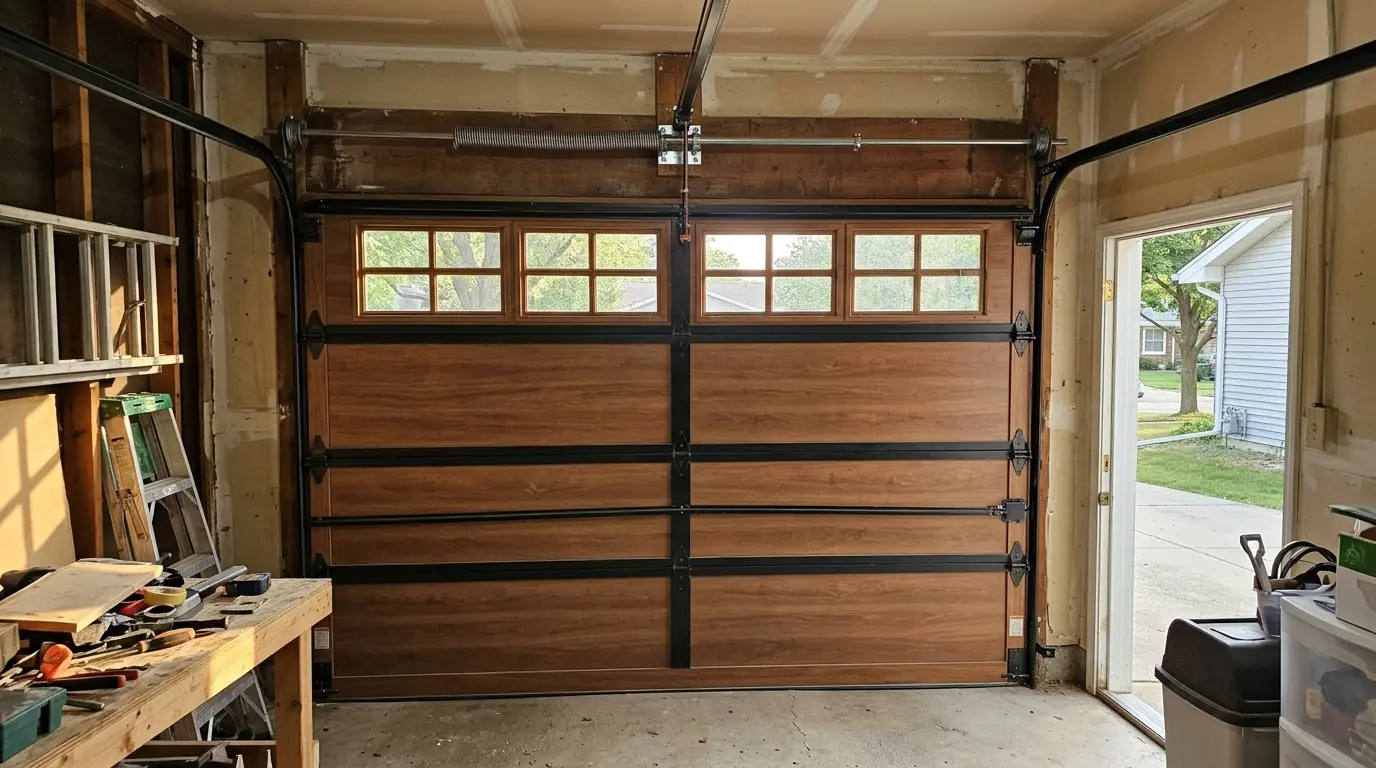
Converting a single-car door
Single doors are usually the simpler conversion, with one spring on a short shaft. The center plate still needs solid framing above the opening, and older garages sometimes have a header that was only meant to carry trim. We look before we quote, and if the framing needs blocking we say so up front.
Two-car door conversion
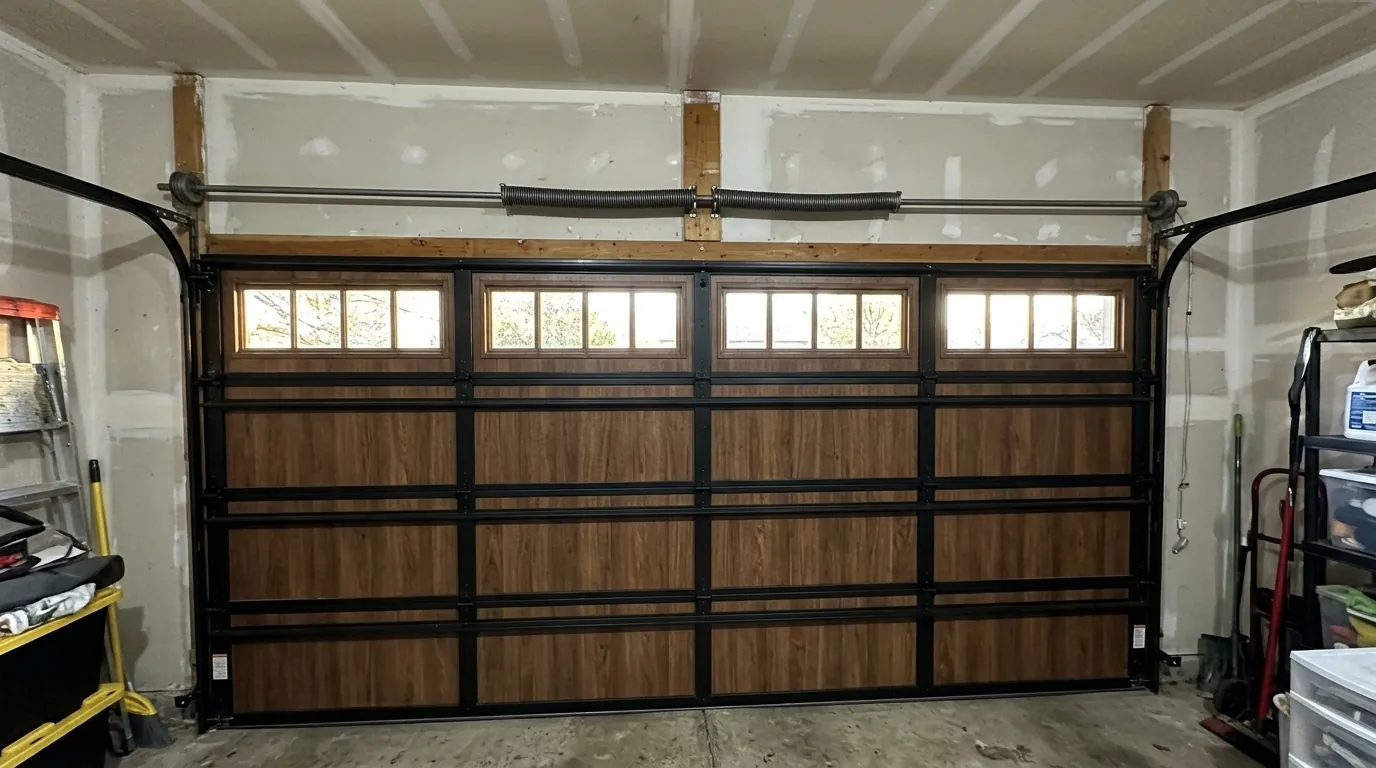
Converting a two-car door
On a two-car door the conversion usually means a pair of springs either side of the center plate and a full-width shaft. Heavier doors, especially insulated ones with windows, are where the even lift of a torsion system is most noticeable, because the door no longer twists as it starts to rise.
Low-headroom conversion
Low-headroom conversions
Some garages have very little space between the top of the opening and the ceiling. A standard torsion shaft may not fit there, but low-headroom hardware and rear-mount arrangements can. They change the track layout as well as the springs, so we measure the clearance first and tell you which version fits before you commit.
Around Naperville
Older Naperville garages and side springs
In Bay Colony, where most homes went up in the 1970s, and in Moser Highlands, built mostly in the late 1950s and early 1960s, a door that has never been converted may still hang on side extension springs. Those are also the garages where the framing above the opening is oldest, so we check the header before mounting a center bearing plate and add solid blocking when the existing wood will not hold the load.
Do it yourself or call
Parts of a conversion you can and cannot do
Measuring is fine. Anything involving the springs under tension is not.
Fine to do yourself
- Measure the space between the top of the opening and the ceiling
- Photograph the side springs, pulleys and tracks for the call
- Clear stored items off the header area before the visit
Leave to a technician
- Releasing tension from the old extension springs
- Anchoring the center bearing plate into the header
- Winding the new torsion springs
- Setting cable tension evenly on both drums
How the visit runs
How a conversion visit runs
- 1
Measure the headroom
We confirm a shaft fits before anything comes off the door.
- 2
Release the side springs
Tension comes off the extension springs and the old hardware is removed.
- 3
Mount the shaft
Center plate into solid framing, end plates square to the tracks.
- 4
Fit and wind springs
Sized to the door's weight, wound to the right number of turns.
- 5
Balance and test
Halfway test, opener reset, photo eyes and safety reverse.
Answers
Questions about extension to torsion spring conversion
Most attached garages do, but some have very little headroom. We measure the space above the opening first, and low-headroom hardware covers many tight garages.
Yes. The opener is reset for the new balance, with its force and travel limits adjusted and the safety reverse tested before we leave.
Both are safe when installed correctly. Extension springs rely on containment cables; torsion springs stay on the shaft when they break. A torsion system also lifts the door more evenly.
Yes, and it is a common time to do it, since the side springs are being replaced anyway. We secure the door first, then convert.
Usually not. A new door comes with its own torsion system sized to it, so if replacement is close, put the money toward the new door.
Same group
Related door work we handle
Torsion Spring Replacement
The broken spring over the door replaced, sized to the door's real weight.
Extension Spring Replacement
Side-mounted springs replaced with containment cables threaded through them.
Garage Door Tune-Up
A balance test, a safety reverse check and tightened hardware before winter.